AEO vs GEO: What Each One Is, How They Differ, and What to Do About Both

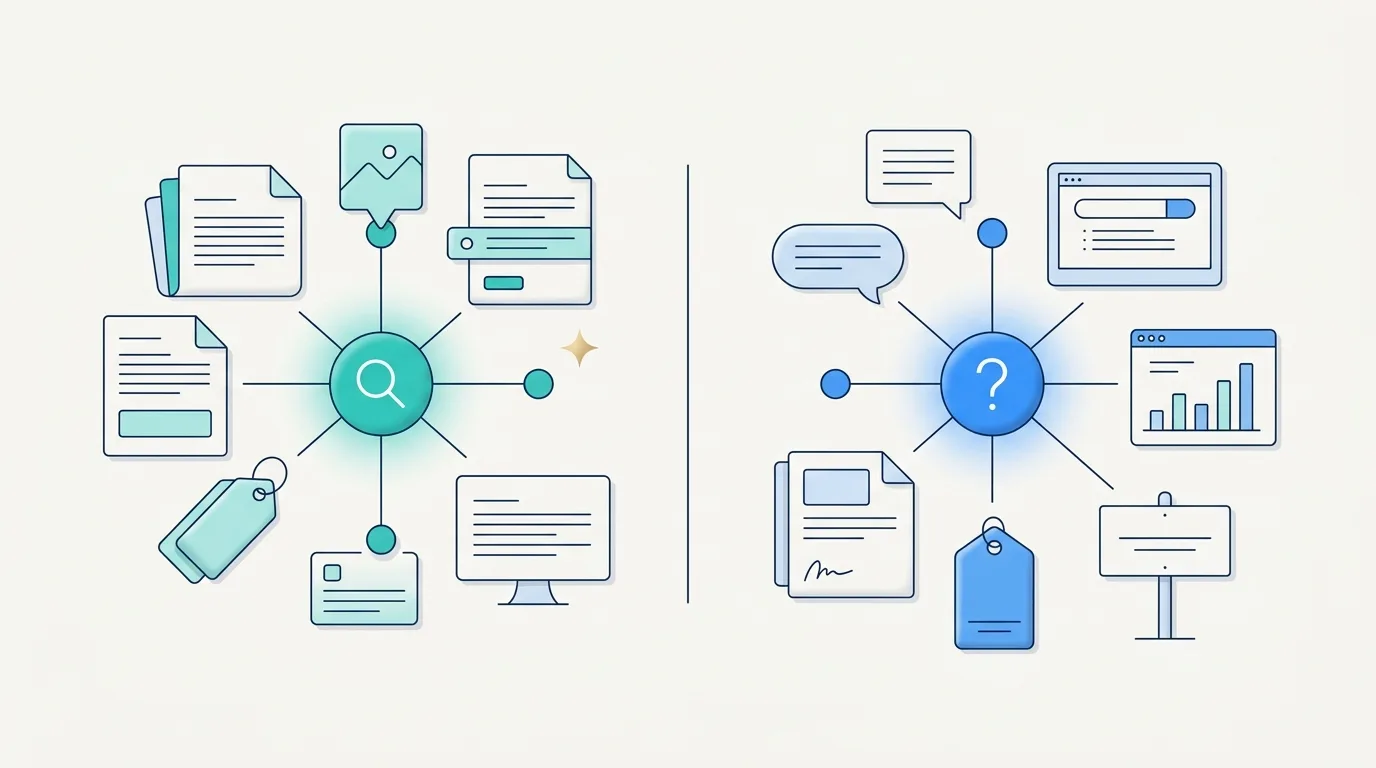

AEO and GEO get used interchangeably. They should not be. Both involve AI. Both are positioned as the future of search beyond traditional SEO. But the platforms are different, the mechanics are different, the timelines are different, and the content requirements are completely different. Treating them as the same thing means you will fail at both.
AEO targets Google's AI features. GEO targets ChatGPT, Perplexity, and Gemini. One is a format problem. The other is a substance problem. Both need to be solved separately.
What Changed: AI Fragmented Search Into Three Channels
AI did not just change how content gets created. It changed how people find it. It split search into three distinct channels, each with different mechanics and different optimization requirements.
Gartner reports that 25% of organic search traffic is shifting from Google to AI chatbots in 2026. People are asking ChatGPT and Perplexity instead of typing queries into a search bar. That shift is happening now.
At the same time, Google itself is intercepting more queries with AI-generated answers. Fewer searches make it to a traditional blue-link results page. A growing share never leave Google at all.
The result is three distinct search channels:
- SEO: Rank in Google's traditional results. Goal is top-10 position. People click through to your site.
- AEO: Be selected as the answer in Google's AI features. Goal is extraction before the click. The person may never visit your site.
- GEO: Get cited by AI chatbots. Goal is citation in ChatGPT, Perplexity, or Gemini responses. The person is not on Google at all.
Most businesses are optimizing for one channel. The competitive advantage belongs to whoever builds presence on all three.
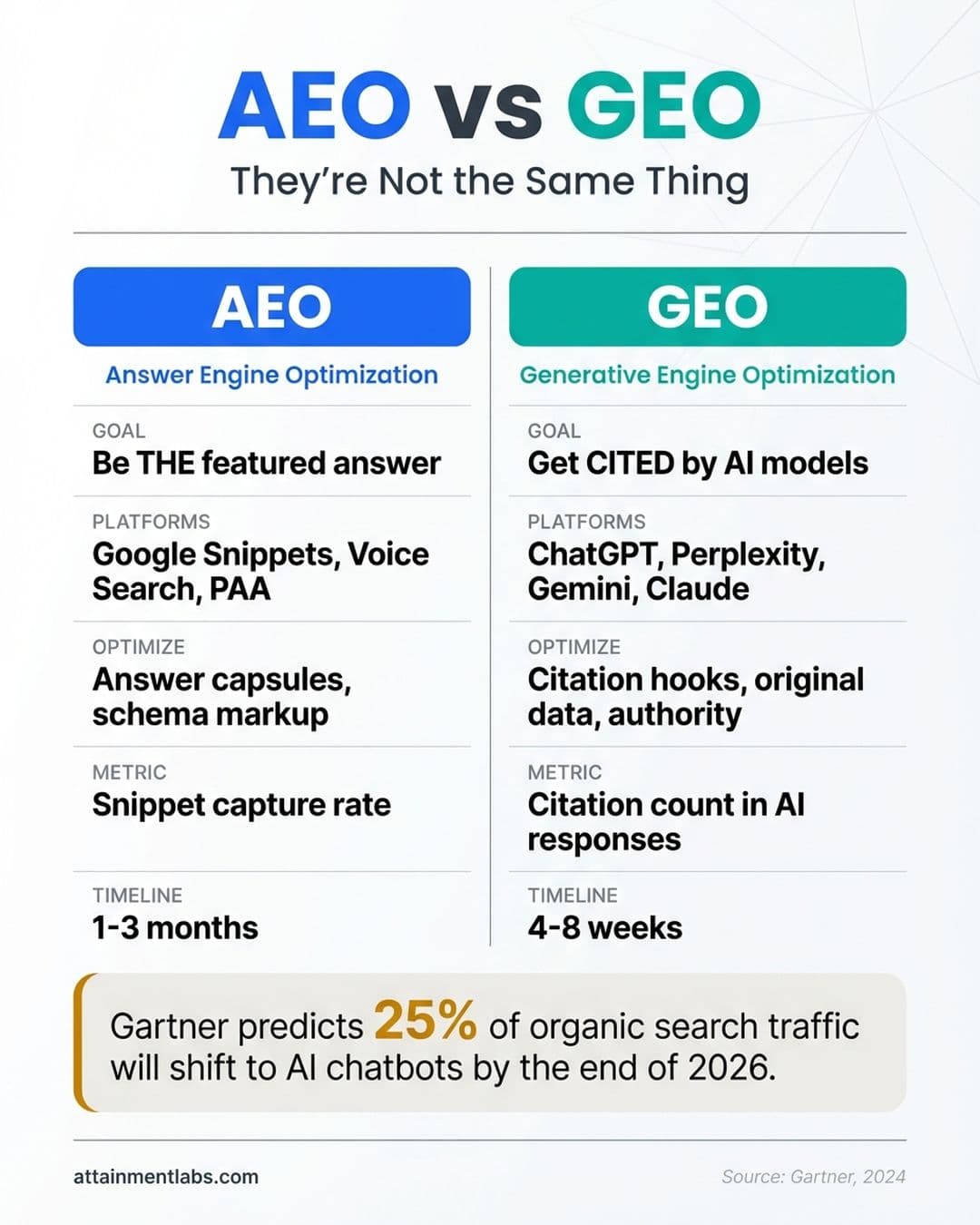
AEO vs GEO at a Glance
AEO and GEO target different ecosystems, require different content strategies, and operate on completely different timelines.
| AEO | GEO | |
|---|---|---|
| Full name | Answer Engine Optimization | Generative Engine Optimization |
| Ecosystem | Google (snippets, PAA, voice, AI Overviews) | ChatGPT, Perplexity, Gemini, Claude |
| Goal | Be the featured answer | Get cited by AI models |
| Core problem | Format: is your content extractable? | Substance: does your content contain something unique? |
| Key tactics | Answer capsules, FAQ schema, direct sentences | Original data, named author, cited statistics |
| Timeline | 30 to 60 days | 6 to 12 months |
| Metric | Snippet capture rate | Citation count in AI responses |
What Is AEO (Answer Engine Optimization)?
AEO is the practice of formatting your content so Google selects it as the direct answer in featured snippets, People Also Ask boxes, and voice search results, before any click happens.
AEO operates entirely within the Google ecosystem. When someone types a question into Google, they increasingly see the answer directly on the results page before any links. A featured snippet at the top. A People Also Ask box with expandable answers. A voice search result that reads one source out loud. An AI Overview that synthesizes multiple sources.
These are all AEO placements. The person searching may never click through to any website. They got the answer from Google's interface, pulled from a specific source. AEO is the practice of making sure that source is you.
The optimization is not about ranking higher. It is about being extractable. Google's system needs to pull a clean, direct answer to a specific question. Most content is not written for that. It is written for comprehensiveness: long-form, covering every angle, designed to rank for a cluster of keywords. AEO requires something different.
What AEO Is Not
AEO is not the same as SEO. SEO aims to rank in traditional blue-link results. AEO aims to be selected as the direct answer in Google's AI-powered features. A page can rank on page one for SEO and never appear in a featured snippet. They are related but distinct optimization tracks.
What Does AEO Require?
AEO requires three structural changes: answer capsules at the top of every section, FAQ schema markup, and format matching to question type. Results show up in 30 to 60 days.
- Answer capsules at the top of every section. Write the direct answer in the first two sentences of each section. Not after background context. The direct answer comes first, then the explanation follows. Google pulls from the opening sentences of a section when generating snippets. If your answer is buried in paragraph four, it will not be selected.
- FAQ schema markup. FAQPage schema dramatically increases the probability that your Q&A content appears in People Also Ask boxes and voice search results. On WordPress, a plugin handles this. On a custom stack, it is a JSON-LD block that takes 15 minutes to implement. This is the single fastest-return technical change in AEO.
- Format matching to question type. "What is" questions get answered with a single sentence. "How to" questions get answered with numbered steps. "Why" questions get a direct causal statement. Google pattern-matches format to query type. If your "how to" content is written in paragraph form, it competes poorly against properly formatted step-by-step content.
What Is GEO (Generative Engine Optimization)?
GEO is the practice of building content that AI models like ChatGPT, Perplexity, and Gemini trust enough to cite when generating responses to user queries.
GEO operates outside the Google ecosystem entirely. When someone types a question into ChatGPT or Perplexity, an AI model generates a response and cites sources. Those sources were not chosen randomly, and they were not chosen through Google's ranking algorithm. They were chosen because the AI model learned to trust them during training and retrieval.
GEO is a fundamentally different problem from AEO. Google's featured snippet pulls your existing page if it is formatted correctly. ChatGPT cites you because your content adds something the model could not find everywhere else. Generic content does not get cited. It gets summarized and ignored.
Why Generic Content Fails at GEO
AI models are trained to cite sources that contribute unique information. A page that restates commonly available facts adds nothing to the AI's response. The model already has that information from dozens of other sources. It has no reason to cite you specifically over any of them.
The companies that earn citations are the ones publishing content that contains information the AI cannot find anywhere else. That is the core GEO problem.
What Does GEO Require?
GEO requires two things: original data that does not exist elsewhere, and structured authority signals that tell AI models the source is credible. Results compound over 6 to 12 months.
- Original data. If your content contains a statistic that does not exist elsewhere, AI models will cite it. "43% of our surveyed clients reduced accounts payable processing time by more than half within 60 days of AI implementation." That number came from you. A model responding to a query about AP automation will cite it because it adds something to the answer that generic content cannot. The data does not need to be from a large-scale study. A conversion rate from your own client work, an average timeline from your project history, or a cost reduction you have documented all qualify. What matters is that the number is real, attributed, and not available anywhere else.
- Structured authority. A clear author name, professional credentials, publication date, and organization name. Models use these signals to assess whether a source is worth citing. Authorless content, undated pages, and generic copy all reduce citation probability significantly. This is why personal bylines matter for GEO even on company blogs. An article attributed to a named person with credentials and a date signals credibility. An article with no author and no date signals nothing.
Why AEO and GEO Require Different Strategies
AEO is a format problem. GEO is a substance problem. A page optimized for one will not automatically perform in the other. They require parallel optimization tracks.
Most businesses that hear about AEO and GEO assume the same fix works for both: write cleaner content, add some schema, done. That assumption produces mediocre performance on both channels.
A page optimized for AEO (answer capsules, FAQ schema, direct sentence construction) will not automatically earn GEO citations. The format is correct, but if the content contains no original data, AI models have no specific reason to cite it over dozens of similar pages covering the same topic.
A page with original data and structured authority will not automatically get pulled into Google's featured snippets if the answer is not formatted for extraction. The substance is there, but if the direct answer is buried in paragraph four instead of the opening two sentences, Google's system will not select it.
Both optimizations can be applied to the same content. A well-built page can serve both channels. But they require parallel attention, not a single fix.
Business Impact by Industry
The impact of AEO and GEO is highest for businesses where customers research before buying. AI models are already in that research process.
Healthcare practices. Before someone books a consultation, they ask what the best treatment option is for their specific situation. In 2020 they Googled that. In 2026, a growing percentage ask ChatGPT. If a competing practice has GEO-optimized content cited in that answer, they are in the consideration set before anyone picked up the phone.
Home services companies. A property manager asks Perplexity what a commercial HVAC maintenance contract should cost in their city. If your website has original pricing data and a well-structured answer, you get cited. If your site has a contact form and four paragraphs of generic copy, you do not.
Professional services firms. A PE operating partner asks ChatGPT what strong AI automation integration looks like for a portfolio company's accounts payable function. If you have published detailed, original content on that topic with cited data and a named author, your firm's name appears. If you have a services page, it does not.
The companies that get cited early build a compounding advantage. AI models develop citation preferences based on what they have seen. Early presence leads to more visibility, which leads to more content being indexed, which leads to more citations.
How to Start With Both Channels
Start with AEO for faster return, then build GEO in parallel. Neither requires a new website or an agency. Both require content that contains something only you could provide.
Your First AEO Move
- Identify the most common question your customers ask before they buy.
- Go to the page on your site most relevant to that question.
- Write a direct, two-sentence answer at the very top of the main content section, before any context or background.
- Add FAQ schema to that page.
- Repeat on your three most important pages.
You can complete this week.
Your First GEO Move
- Find one original data point you have that is not publicly available: a conversion rate, average timeline, or documented cost reduction from your own work.
- Write one section or article that uses that statistic to answer a question your customers ask.
- Attribute the statistic clearly to your organization.
- Publish it with a named author and a visible publication date.
You can complete this month.
Key Takeaways
- AEO and GEO target different ecosystems: AEO is Google, GEO is ChatGPT, Perplexity, and Gemini.
- AEO is a format problem: can Google extract a clean answer from your page?
- GEO is a substance problem: does your content contain something unique that AI models will cite?
- AEO requires answer capsules, FAQ schema, and format matching. Results in 30 to 60 days.
- GEO requires original data and structured authority signals. Results compound over 6 to 12 months.
- A page can be optimized for both, but they require parallel attention, not a single fix.
- Gartner predicts 25% of organic search traffic will shift to AI chatbots by the end of 2026. That shift is already underway.
- Companies that build AEO and GEO presence now will own that space for years. The companies waiting will find the positions taken.
Frequently Asked Questions
What is the difference between AEO and GEO?
AEO (Answer Engine Optimization) targets Google's AI-powered features: featured snippets, People Also Ask boxes, and voice search results. GEO (Generative Engine Optimization) targets AI chatbots like ChatGPT, Perplexity, and Gemini. AEO is a format problem: your content needs to be extractable. GEO is a substance problem: your content needs original data and structured authority that AI models trust enough to cite.
Is AEO the same as SEO?
No. SEO aims to rank your pages in Google's traditional blue-link results. AEO aims to have your content selected as the direct answer in featured snippets, voice results, and People Also Ask boxes. SEO is about ranking position. AEO is about answer selection. A page can rank on page one for SEO and never appear in a featured snippet.
How long does AEO take to show results?
AEO results typically appear in 30 to 60 days with consistent implementation of answer capsules, FAQ schema, and direct-answer formatting. It is the fastest-return channel of the three.
How long does GEO take to show results?
GEO takes 6 to 12 months to compound. AI models build citation preferences over time as your content gets indexed, referenced, and used as a retrieval signal. Companies that start now have a structural advantage that is difficult for late entrants to replicate.
Can the same content work for both AEO and GEO?
Partially. Both benefit from structured, well-formatted content with clear headings. But AEO specifically requires answer capsules and FAQ schema, while GEO specifically requires original data and named author credentials. A page optimized for AEO will not automatically earn GEO citations, and vice versa. They require parallel optimization tracks.
Which businesses benefit most from AEO and GEO?
Businesses where customers research before buying see the highest impact. This includes healthcare practices, professional services firms, home services companies, and any business where a competitor being cited in an AI response means they enter the consideration set before you do.
David Cyrus is the founder of Attainment, an AI-powered profit maximization firm.

Founder & Managing Director, Attainment
David Cyrus is the founder of Attainment. He writes about missed revenue, manual work, AI automation, and the operating decisions behind what to fix first.
Connect on LinkedInFind the Problem Worth Fixing First
Tell us where revenue, follow-up, or staff time is getting stuck. We will help you decide whether the problem is measurable and worth fixing.