AI Is Eating Software: The Three Moats That Survive

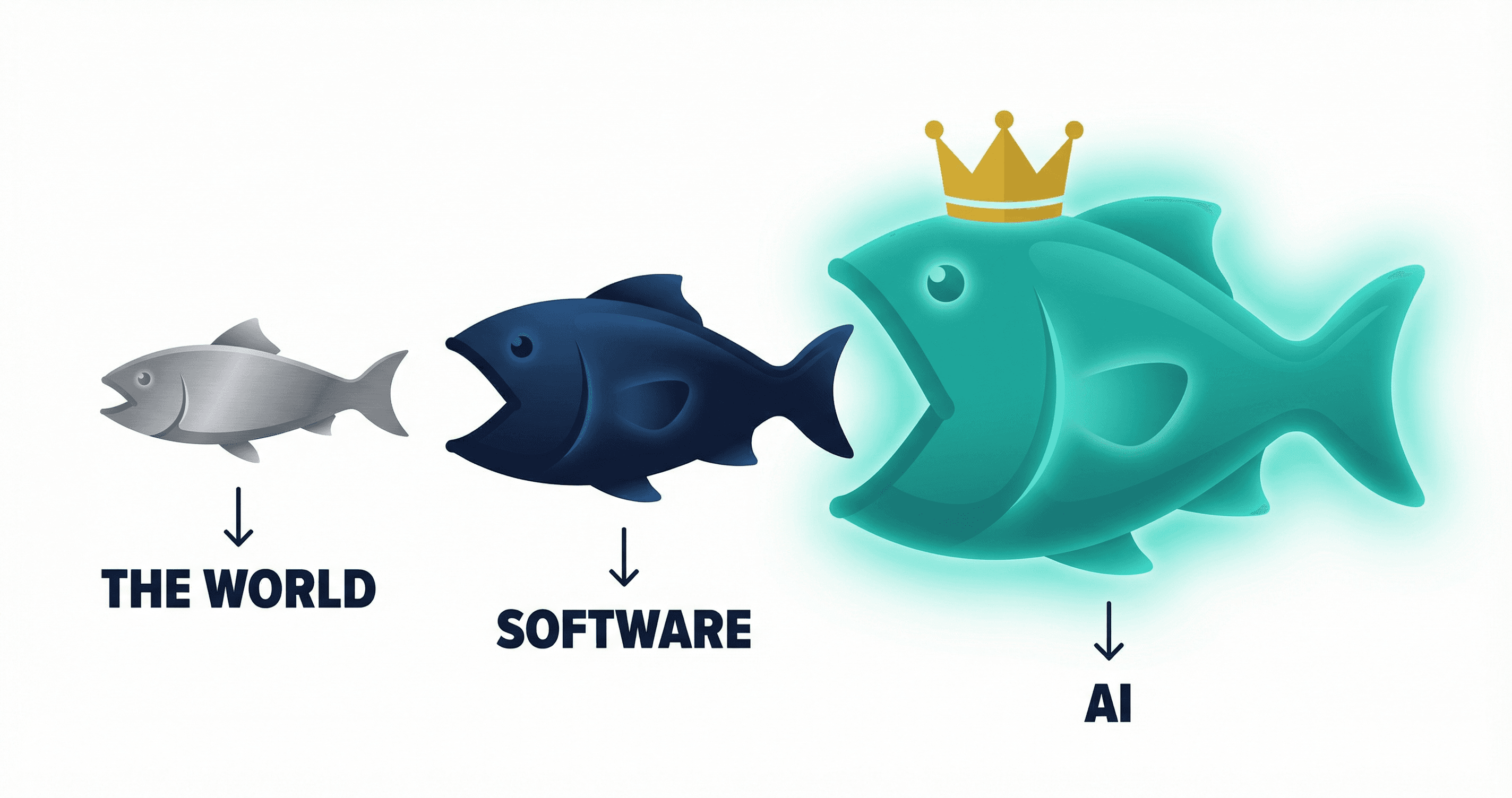
In 2011, Marc Andreessen wrote that software is eating the world. He was right. Salesforce ate the Rolodex. Slack ate the memo. Shopify ate the storefront. Zoom ate the conference room. Stripe ate the payment terminal. The SaaS era created over $700 billion in annual recurring revenue and tens of trillions in market capitalization.
“Software is eating the world, and now AI is eating software.”
Naval Ravikant (@naval), December 2025
Now AI is eating software. The companies that won the last wave are often the most exposed in this one. Three categories survive: data moats, compliance infrastructure, and systems of record. Everything else has a clock on it.
What the Software Wave Actually Did
The software wave was a distribution story, not a capability story. Understanding that distinction is the key to understanding why the AI wave is so much more threatening.
Salesforce did not invent contact management. Rolodexes and Access databases already handled customer relationships. Salesforce made contact management accessible without a $500,000 Oracle deployment, a dedicated IT team, and a six-month implementation. The underlying task did not change. The delivery mechanism did.
The same pattern repeated across every SaaS category. Slack did not invent team communication. Email and instant messaging already existed. Slack made communication faster, more organized, and searchable without a corporate IT deployment. Shopify did not invent retail. It made retail accessible without a physical lease and a payment terminal contract.
Every major SaaS winner of the last 20 years followed the same playbook: find a workflow that required too much capital or technical expertise to access, package it cleanly, and sell it as a subscription. The innovation was distribution. The task remained unchanged.
That is exactly why the AI wave is different. And exactly why most SaaS companies are not pricing the exposure correctly.
Why This Wave Is Structurally Different
Software ate delivery. AI eats the task itself. When a $20 per month subscription can perform the core function of a $200 per month per seat product, the distribution advantage disappears entirely.
When a $20 per month Claude subscription can draft a contract, summarize a legal document, write a compliance report, build a competitive analysis, generate a sales email sequence, or produce a financial model, the question is not how to distribute those tasks more efficiently. The question is why a company pays $200 per month per seat for software that wraps the same output in a workflow.
This is not a hypothetical. It is already happening at the edges of the market. Enterprise buyers are building internal AI tools that replace point solutions. Development teams that previously needed a specific SaaS product for every task are now building custom solutions with AI assistance in days instead of months. The barrier to building the alternative has collapsed.
According to Gartner, 25% of organic search traffic will shift to AI chatbots by the end of 2026 (Gartner, 2024). The same displacement is beginning in software. AI alternatives are capturing addressable use cases, starting at the edges and moving toward the core. The question is not whether this happens. The question is what creates durable value after it does.
The pattern is already visible in early enterprise behavior. Microsoft CEO Satya Nadella told the Invest Like the Best podcast: "Business applications could collapse in the agent era." He was not warning about fringe software. He was describing the core of his own product portfolio. When the CEO of a $3 trillion company flags existential risk to his own category, it is worth taking seriously.
Chris Paik at Pace Capital articulated the structural argument in his "The End of Software" framework: the traditional SaaS model, UI over a database with per-seat pricing, worked because the UI was the product. If the UI layer becomes an AI chat interface, the database beneath it becomes a commodity. The interface builder loses pricing power. Whoever owns the underlying data and the downstream workflow wins.
Naval Ravikant made it more direct in November 2025: "UI is pre-AI." Every interface built around menus and form fields was designed for a world before users could simply describe what they want. That world is ending. The products that survive are not the ones with the best UI. They are the ones with something the AI layer cannot replicate.
Three Moats That Survive
Not all SaaS is equally exposed. Three categories have structural advantages that general-purpose AI cannot replicate, regardless of how capable the models become.
1. Data Moats
If your product sits on proprietary data that nobody else can access, you are defensible. The moat is not the software. The moat is what the software has been ingesting over years of operation, and what that data allows you to do that no competitor can replicate.
Veeva Systems is the clearest example. Veeva owns pharmaceutical CRM relationships: the call notes, sample tracking, rep performance data, and physician engagement history across every major pharma company, accumulated over more than 20 years. That dataset cannot be synthesized from public sources. A general-purpose AI cannot recreate it. The relationships and regulatory context embedded in that data are not features. They are the product. Veeva's market cap reflects a moat that compounds with every interaction.
Procore owns construction project history: the change orders, the RFIs, the subcontractor communications across hundreds of thousands of projects representing trillions in construction value. CoStar Group has spent 35 years building a proprietary commercial real estate database that includes every lease transaction, sale price, and property detail in the US market. That data took decades and billions of dollars to collect. No AI can replicate it by scraping public records. Bloomberg Terminal charges $24,000 per year not because the interface is elegant, but because 40 years of real-time financial data, with institutional trust and proprietary feeds, cannot be commoditized.
The pattern across all of these: proprietary data compounds over time. The longer the product operates, the deeper the moat becomes. Some data moats also benefit from data network effects: every new user interaction makes the dataset richer, which makes the product more accurate, which attracts more users. This is structurally different from regular network effects. The product is not just more valuable with more users. It is more intelligent.
Palantir represents an extreme version of the data moat: government and intelligence contracts that involve classified data no competitor can access. The moat is not just proprietary. It is legally exclusive.
The companies building data moats today are making deliberate decisions about what they ingest and how they enrich it over time. They treat data strategy as a product decision, not an infrastructure decision. Every customer interaction is an opportunity to accumulate proprietary signal. The companies that understand this are building assets that compound. The ones treating data as a byproduct of transactions are accumulating commodity information with no defensive value.
2. Compliance Infrastructure
Regulated industries do not get to opt out of compliance requirements, regardless of how capable AI becomes. Healthcare, finance, and legal have structural constraints that create long replacement cycles and high switching costs for compliant software.
The compliance infrastructure these companies sit behind took years to build: HIPAA certifications, SOC 2 Type II reports, FDA validation for clinical systems, FedRAMP authorization for government contracts, PCI DSS compliance for payment systems, FINRA and SEC regulatory approvals for financial software. These certifications require audits, process documentation, and sustained operational compliance. Most take two to five years to establish. They cannot be bought off a shelf.
A hospital system will not replace Epic with a Claude prompt. The question is liability. A HIPAA violation costs healthcare organizations between $100 and $50,000 per violation, with annual caps reaching $1.9 million per category (U.S. Department of Health and Human Services, 2023). The compliance infrastructure is the product. No general-purpose AI subscription comes with an audit trail that satisfies a Joint Commission inspection.
nCino has built a banking operating system with OCC and FDIC regulatory approval requirements baked into the product. Finastra and Temenos power core banking systems at institutions where switching means regulators, auditors, and boards must approve the migration. These are not just software replacements. They are multi-year regulatory events.
AI will eventually penetrate regulated industries. The replacement cycle in regulated markets is measured in years, and that timeline alone is a structural advantage. Maintaining it requires ongoing compliance investment, which is a very different kind of work than shipping features.
3. Systems of Record
If everything else in a company's stack connects to your tool, the switching cost is structural and compounding. The product does not have to be good. It has to be embedded.
Salesforce is defensible not because Salesforce is great software, but because over 3,000 applications in its AppExchange ecosystem connect to it. The CRM has become the spine of the enterprise stack. Customer data flows into Salesforce from marketing tools, out to support tools, across to finance systems, and up to executive dashboards. Unplugging it does not mean migrating data. It means renegotiating every one of those integrations simultaneously, rebuilding workflows, retraining teams, and absorbing months of operational disruption.
The same dynamic applies to Workday in HR and finance, ServiceNow in IT operations, and SAP in enterprise resource planning. The product quality across all three ranges from adequate to actively frustrating. The switching cost is catastrophic. That gap between product quality and retention rate is the moat.
Systems of record also benefit from what might be called API gravity. When your product becomes the source of truth for a category of data, other tools make API calls to you. They build on top of you. They treat you as infrastructure. Every new tool that integrates with you increases the cost of your removal. The longer you hold this position, the more structurally irreplaceable you become, independent of whether your product improves.
The AI Features Trap
The most dangerous response to AI disruption is adding AI features to a product that has none of the three moats. This is not a defensive strategy. It is a delay tactic that consumes the engineering resources needed to actually build a structural advantage.
Every SaaS company is adding AI features right now. AI-powered insights. Smart summaries. Automated workflows. ChatGPT integrations. Predictive analytics. These features are table stakes in 2026, not differentiators. A buyer evaluating two project management tools is not choosing based on which one has AI summarization. They are choosing based on price, integrations, and switching cost.
Adding AI summarization to your note-taking tool does not create a data moat. Adding a "smart assistant" to your CRM does not create compliance infrastructure. Building an AI-powered dashboard on top of your project management product does not increase integration gravity. These features improve the product experience. They do not change the structural question of whether the product has a moat.
The companies falling into the AI features trap are doing two things simultaneously: spending engineering capacity on features that will be commoditized within 12 months, and avoiding the harder conversation about whether the underlying business is defensible. The AI feature roadmap becomes a proxy for a moat strategy without actually being one.
The companies worth watching are the ones that are using AI to accelerate their path to a structural moat: using AI to ingest and enrich proprietary data faster, using AI to automate compliance documentation and reduce the time to certification, using AI to build integrations that deepen systems-of-record status. That is the difference between using AI as a feature and using AI as a moat-building tool.
What Gets Eaten
Everything outside the three moats is at material risk. The clearest test: if you can describe your product's core function in one sentence to Claude and get an 80% solution in 30 seconds, you are a feature dressed as a business.
Project management tools (Asana, Monday.com, Basecamp) are workflow layers. They track tasks, assign owners, and display status. A general-purpose AI can generate a project plan, track progress through integrations, and surface blockers without a dedicated project management subscription. The question for these companies is whether years of project data creates a proprietary benchmark dataset. Some are pursuing that angle. Most are not.
Knowledge management and note-taking platforms (Notion, Confluence, Coda) add UI to information storage. They do not own the information. The data belongs to the customer and can be migrated. A general-purpose AI with a good document interface replicates the core value proposition without the per-seat cost.
Basic CRM for SMBs (the non-Salesforce tier) has almost no moat. No proprietary data. Low switching costs. No compliance requirement. An AI that can manage customer follow-ups, draft outreach emails, and log interaction history directly in a business's existing tools removes the reason to pay for a separate CRM subscription.
Customer support ticketing software without proprietary data faces structural pressure from both directions: AI handling tier-1 support directly (reducing ticket volume) and AI building better routing and resolution tools that don't require a separate platform purchase.
The uncomfortable truth is that most SaaS companies were never building moats. They were building distribution. They found an underserved workflow, packaged it cleanly, and sold subscriptions at a price that was justified only because the alternative, building internally, was prohibitively expensive.
That cost has collapsed. A development team of two engineers with AI assistance can now build in three months what previously required a ten-person team and twelve months. The pricing power that came from being the only reasonable option is eroding category by category.
The evidence is moving from anecdote to data. According to Bain & Company, 35% of enterprises have already replaced at least one SaaS tool in the past 12 months (Bain & Company, 2025). Klarna cancelled its Salesforce and Workday contracts in 2024, replacing both with internal AI tools. A company processing over 2 million transactions per day decided that its CRM and HR systems were no longer worth the cost. When the most data-intensive segment of the market starts cancelling, the pricing power assumptions embedded in software valuations need to be revisited.
| Category | Moat Type | AI Exposure | Examples |
|---|---|---|---|
| Proprietary data platform | Data moat | Low | Veeva, Procore, Bloomberg, CoStar |
| Regulated industry software | Compliance | Low (long cycle) | Epic, Cerner, nCino, Veeva Vault |
| Enterprise system of record | Integration gravity | Low | Salesforce, Workday, SAP, ServiceNow |
| Project management | Weak / None | Medium-High | Asana, Monday.com, Basecamp |
| Knowledge management | None | Very High | Notion, Confluence, Coda |
| SMB CRM (no data moat) | None | Very High | HubSpot Starter, Pipedrive, Zoho CRM |
| Productivity / UI layer | None | Very High | Calendly, Loom, Typeform, Zapier |
The Valuation Gap That Is Coming
Software companies are still being valued as if the moats are intact. The market has not fully priced the distinction between defensible and vulnerable SaaS. That gap will close, and it will close in growth rates before it closes in multiples.
The median enterprise SaaS company trades at 5 to 8 times revenue. The market is pricing in durable pricing power, low churn, and long customer lifetime value. Those assumptions were defensible in 2021, when the alternative to a SaaS product was either a legacy on-premise system or building from scratch. Neither option was attractive. The SaaS product won by default.
That default position is eroding. The companies with data moats and compliance infrastructure will hold pricing and retain customers because switching remains genuinely painful. Feature-layer products will face pricing pressure first, then churn, then contraction in growth rates that cannot be explained away in quarterly calls.
The valuation separation between defensible and vulnerable SaaS should be significant: companies behind genuine moats deserve the 8 to 12 times revenue multiples that durable businesses command. Feature-layer products with no structural protection should trade at 2 to 4 times revenue, reflecting the execution requirement to reach a moat before the category commoditizes.
The financial markets are beginning to price in some of this risk. According to Bloomberg, $1 to $2 trillion in software company valuations has been erased since the AI wave accelerated in 2023, as investors reassess which SaaS categories have durable pricing power (Bloomberg, 2024). Goldman Sachs Global Investment Research projects that AI agents will account for more than 50% of software economics by 2030 (Goldman Sachs Global Investment Research, 2024). That is not a marginal shift. That is a structural reallocation of where value accrues in the stack.
Investors who can identify the distinction before it is reflected in growth metrics will find significant opportunity on both sides. Long positions in genuinely moated companies that are trading at feature-layer multiples. Short positions in feature-layer products that are still priced as category leaders.
The Attainment SaaS Moat Index 2026
To test whether the market is actually pricing moat strength, we scored 21 publicly traded SaaS companies on three dimensions and cross-referenced against real EV/Revenue multiples. The result: moat score predicts the floor, not the ceiling.
Every company was rated 1 to 3 on each of the three moat dimensions: data moat (proprietary data accumulation and defensibility), compliance infrastructure (regulatory certifications and audit requirements that create structural switching costs), and integration gravity (how deeply embedded the tool is in adjacent systems). Maximum score is 9. EV/Revenue multiples are LTM figures sourced from multiples.vc as of February 2026.
| Company | Data | Compliance | Integration | Score /9 | EV/Revenue |
|---|---|---|---|---|---|
| Palantir | 3 | 3 | 2 | 8 | 67.3x ⬆ |
| ServiceNow | 2 | 3 | 3 | 8 | 8.2x |
| SAP | 2 | 3 | 3 | 8 | 5.4x |
| Veeva Systems | 3 | 3 | 2 | 8 | 7.2x |
| Workday | 2 | 3 | 3 | 8 | 3.7x |
| nCino | 2 | 3 | 3 | 8 | 3.5x |
| Snowflake | 2 | 2 | 3 | 7 | 13.5x ⬆ |
| Datadog | 2 | 2 | 3 | 7 | 9.8x ⬆ |
| Procore | 3 | 2 | 2 | 7 | 5.7x |
| Salesforce | 2 | 2 | 3 | 7 | 4.3x |
| Atlassian | 2 | 2 | 3 | 7 | 3.8x |
| DocuSign | 2 | 3 | 2 | 7 | 2.6x |
| CoStar | 3 | 1 | 2 | 6 | 5.8x |
| Box | 1 | 3 | 2 | 6 | 3.3x |
| Twilio | 1 | 2 | 3 | 6 | 3.1x |
| Braze | 2 | 2 | 2 | 6 | 2.3x |
| Zoom | 1 | 2 | 2 | 5 | 4.0x |
| HubSpot | 2 | 1 | 2 | 5 | 3.7x |
| Dropbox | 1 | 2 | 1 | 4 | 3.4x |
| monday.com | 1 | 1 | 2 | 4 | 7.9x ⬆ |
| Asana | 1 | 1 | 1 | 3 | 2.0x |
Scoring: Data Moat + Compliance Infrastructure + Integration Gravity (each 1-3, max 9). EV/Revenue: LTM multiples sourced from StockAnalysis.com, cross-referenced with GuruFocus and Yahoo Finance, February 2026. ⬆ denotes companies with significant growth or AI infrastructure premium in addition to moat score.
What the Data Shows
The moat score does not predict the multiple. It predicts the floor. Every company in this index with a score of 7 or higher trades at a minimum of 2.4 times revenue. No high-moat company in the index has been crushed to 1 to 2 times revenue, which is where commodity software eventually prices. The moat is a floor.
The ceiling is driven by growth rate and AI narrative. Palantir (8/9, 67.3x), Snowflake (7/9, 12.7x), and Datadog (7/9, 9.8x) combine strong moat scores with aggressive AI infrastructure positioning. Their premium is moat plus growth narrative. Remove that AI premium and they would likely trade near ServiceNow at 7.6x.
monday.com is the apparent outlier: a moat score of 4 out of 9 with an EV/Revenue multiple of 7.9 times. That is not a contradiction of the thesis. monday.com is growing at approximately 30% annually with strong net revenue retention. The 7.9 times multiple is a growth premium, not a moat premium. The relevant question is what happens when growth decelerates. A company with strong moat scores (Workday at 8/9) compresses to 3.4 times when growth slows. A company with weak moat scores (Asana at 3/9) compresses to 1.8 times. When monday.com's growth slows, there is no structural floor to catch it. That is the risk the current multiple does not fully price.
The Workday result is instructive. It scores 8 out of 9 on moat strength (strong compliance infrastructure, deep integration gravity into HR and finance systems) but trades at 3.4 times revenue. The moat is intact. The growth rate is not. Workday is expensive to replace and will not lose customers quickly, but it is not growing fast enough to command a premium multiple. It trades at the floor its moat provides.
DocuSign tells a different story. It scores 7 out of 9 but trades at 2.4 times revenue, the lowest multiple of any high-moat company in the index. The compliance moat is real (SOC 2, ESIGN Act, eIDAS compliance in Europe) but the category is actively being undercut. AI can now generate, review, and route contracts without a dedicated platform. DocuSign has a moat but its category is commoditizing around it. The market is starting to price that.
At the bottom of the index, Asana at 3.0 out of 9 and 1.8 times revenue illustrates what the floor looks like for feature-layer products with no structural protection. Work management software on a generic database with no proprietary data, no compliance infrastructure, and weak integration gravity. The multiple reflects terminal value, not growth expectations.
The bifurcation between moated and unmoated SaaS is visible in the data. It is going to get more visible as AI compresses the cost of building feature-layer alternatives.
The Moat Index explains the current multiples. The next section explains what is driving the separation.
The Displacement Timeline: It Is Already Happening
The risk to feature-layer SaaS is not a prediction. The following cases are documented, sourced, and dated. The wave started with customer support in 2023. It reached CRM and HCM in 2024. It is now moving into clinical writing, content creation, and GTM operations.
| Year | Company | Category Displaced | Replaced With | Key Result |
|---|---|---|---|---|
| 2017 | JPMorgan Chase | Legal document review software | COiN (internal AI, NLP-based) | 360,000 lawyer hours eliminated per year; 12,000 contracts reviewed in seconds vs. weeks |
| 2023 | Dukaan | Customer support software (23 agents) | Internal AI chatbot (built in 2 days) | Support costs cut 85%; resolution time from 2h 13m to 3m 12s |
| 2023 | Octopus Energy | Contact center workflows | Kraken “Magic Ink” (GPT-4) | Equivalent of 250 full-time agents within 16 weeks; AI emails achieved 80% customer satisfaction vs. 65% for humans |
| 2024 | Klarna | Salesforce CRM | Internal data stack (Neo4j) + AI tools | Part of broader AI overhaul; customer service costs fell from $287M (2022) to $203M (2024) |
| 2024 | Klarna | Workday HCM | Deel (lower-cost alternative SaaS) | CEO publicly stated goal to “shut down a lot of SaaS providers”; $39M in AI-related cost savings in 2024 (Klarna SEC F-1) |
| 2024 | Klarna | 700 FTE customer service agents | OpenAI-powered AI assistant | 2.3M conversations in first month; resolution time 11 min → 2 min. Note: Klarna partially reversed this in 2025, re-hiring agents after quality concerns |
| 2024 | Air India | Call center infrastructure | AI.g chatbot (Azure OpenAI + GPT-4) | 40,000 queries/day; 93% of 1M+ queries auto-resolved; described as “100x” cost reduction |
| 2024 | Duolingo | Content creation and translation contractors | Internal generative AI tools (OpenAI-powered) | 10% contractor reduction (Jan 2024); 148 new language courses created entirely with AI |
| 2024 | Publicis Groupe | ~50% of SaaS stack including Adobe Creative Cloud | CoreAI (OpenAI, Midjourney, RunwayML) | 100,000 employees on platform; €300M investment; licenses reduced 50% |
| 2024–25 | Novo Nordisk | Clinical study report writing (50+ person workflow) | NovoScribe (Claude 3.5 Sonnet + MongoDB + Amazon Bedrock) | 15 weeks → under 10 minutes; team reduced from 50+ to 3 people working alongside AI |
| 2024–25 | ClickUp | Third-party automation software ($200K/year in subscriptions) | Internal AI tools built on Retool | $200K/year saved; hundreds of hours/week of GTM operations automated |
Sources: Bloomberg, Klarna SEC F-1, OpenAI, Anthropic, Microsoft, Retool, TechCrunch, CNN Business, Yorkshire Post, GlobeNewswire. Full citations available on request.
Customer support was the first category to go. The task is discrete, measurable, and the cost savings show up on the next quarterly report. That wave started in 2023 and is now settled. Any company still paying per-seat for generic ticketing software is paying for a solved problem.
By 2024 the wave had reached CRM and HCM. Salesforce and Workday are getting cancelled not because AI can fully replicate their functionality, but because companies decided the functionality is not worth the price relative to what they can now build. When a fintech processing two million transactions per day makes that calculation, it means the pricing power embedded in enterprise SaaS valuations is already eroding.
The Klarna reversal deserves a footnote. After replacing 700 FTE agents and claiming $39M in savings, they re-hired human agents in 2025 after quality scores fell. This does not mean the trend reversed. Transitions have friction. The cost curve still favors AI. The companies that execute the transition well capture the savings permanently. The ones that rush it cycle back, and their competitors use that window to do it right.
Retool's 2026 Build vs. Buy Report (817 enterprise software builders surveyed) puts numbers to the pattern: 35% have already replaced at least one SaaS tool with a custom-built alternative, and 78% plan to build more in 2026. The top categories under pressure are workflow automation (35%), internal admin tools (33%), and BI (29%). CRM and customer support rank lower only because early movers finished those replacements in 2023 and 2024.
What Companies Should Do
The path forward is deliberate movement toward one of the three structural moats. The timeline matters: the window for building a defensible position is narrowing as AI capabilities advance and as well-capitalized competitors make the same moves.
The Audit: Know Where You Stand
Before building anything, answer these questions honestly about your current product:
- Data moat test: What data does your product generate that nobody else has access to? Is that data enriching over time, or is it static transaction records? Could you publish proprietary benchmarks from that data that no competitor could replicate?
- Compliance test: What certifications does your customer base require in their procurement process? Which ones do you currently have? Which ones do competitors have that you do not?
- Integration gravity test: How many tools in your customers' stacks connect to you? Are you becoming infrastructure (other tools depend on you) or staying at the application layer (you depend on other tools)? What is your API usage trend?
If the answers to all three tests are weak, you have a product problem. Not a positioning problem. Not a marketing problem. A product problem that requires a product strategy to solve.
Building the Moat: A Timeline
Months 0 to 6: Audit and select. Complete the audit above. Pick the moat category most accessible from your current product position. A product that already touches proprietary customer data has a clearer path to a data moat than a productivity tool that stores generic content. Do not try to build all three simultaneously.
Months 6 to 12: Start building. For data moats: implement data enrichment pipelines, build benchmark reporting that uses your proprietary dataset, and start publishing insights that establish your data's authority. For compliance: begin the SOC 2 Type II process (platforms like Vanta or Drata cut the timeline significantly), identify which certifications your largest customers require in procurement, and build the operational discipline required to maintain them. For integration gravity: build native integrations with the five tools most commonly in your customers' stacks, create an API that makes you easy to connect to, and position your product as the source of truth for your data category.
Months 12 to 24: Deepen and defend. A moat that is six months old is shallow. Competitors can still close the gap. The objective in year two is to widen the structural advantage: more proprietary data, more certifications, more integrations. Every month of additional investment makes the position more defensible and the cost of competitive replication higher.
What Not to Do
Do not add AI features as a substitute for moat-building. AI summarization, AI-powered insights, and smart automation features are table stakes by 2026. They improve retention at the margin. They do not change the structural question of whether your product survives the commoditization of its core workflow.
Do not wait for the disruption to become undeniable before moving. The companies that start building moats when their growth rate is still strong have the capital and time to do it properly. The companies that wait until churn accelerates will be building under pressure, with fewer resources and a closing window.
Key Takeaways
- Software ate delivery. AI eats the task itself. The SaaS wave was a distribution story. This wave is a replacement story.
- Three categories are structurally defensible: data moats (proprietary datasets nobody else can access), compliance infrastructure (regulated industries with long switching cycles), and systems of record (integration gravity that makes removal catastrophic). Everything else has a clock on it.
- The clearest test: describe your product's core function in one sentence to Claude and get an 80% solution in 30 seconds. If that works, you are a feature dressed as a business.
- The AI features trap: adding AI summarization, smart insights, and automated workflows to a featureless product delays the question. It consumes the engineering resources needed to actually build a structural advantage.
- Enterprise SaaS multiples (5 to 8 times revenue) still price in durable moats that many products do not have. That gap will close in growth rates before it closes in multiples.
- The Attainment SaaS Moat Index 2026 (21 companies, scored across data, compliance, and integration dimensions) confirms: moat score predicts the floor, not the ceiling. No high-moat company in the index trades below 2.4 times revenue. Low-moat companies compress toward 2 times and below.
Did you build a moat, or did you build a dashboard?
Attainment works with SaaS companies and their investors on exactly this question. The moat audit covers all three dimensions: data strategy, compliance gap analysis, and integration gravity assessment. The output is a prioritized plan for building structural defensibility before the window closes.
Run the moat audit on your product.
30-minute session. Walk away knowing where you stand on all three dimensions and what to do about it.
Request a consultationFrequently Asked Questions
Is AI going to replace SaaS software?
Not all of it. AI replaces SaaS products built around workflow delivery without proprietary data. Software with data moats, compliance infrastructure, or systems-of-record status is structurally defensible. Feature-layer products without these advantages are at material risk.
What is a data moat in SaaS?
A data moat is a proprietary dataset accumulated through years of product operation that cannot be replicated by a competitor or general-purpose AI. Examples include Veeva's pharmaceutical rep call notes, Procore's construction project history, Bloomberg's 40-year financial data archive, and CoStar's commercial real estate transaction database. The moat is not the software itself but what the software has ingested over time.
Which SaaS categories are most exposed to AI disruption?
Workflow automation tools with no proprietary data, point solutions on generic databases, vertical SaaS charging per seat for tasks a $20 per month AI subscription can replicate, and productivity software that adds UI to a workflow without creating unique data. Project management tools, basic CRM for SMBs, knowledge management platforms, and customer support ticketing software with no proprietary data are among the most exposed.
Why is compliance infrastructure a moat against AI disruption?
Regulated industries (healthcare, finance, legal) cannot swap in a general-purpose AI to replace compliant software. HIPAA violations cost healthcare organizations up to $1.9 million annually per violation category. Audit trails, certifications, and FDA validation represent years of regulatory work that create switching costs unrelated to product quality. A hospital system will not replace Epic with Claude because the question is not capability. It is liability.
What is integration gravity as a SaaS moat?
Integration gravity is the structural switching cost that builds when a product becomes the system of record that other tools connect to. Salesforce is defensible because over 3,000 apps in its AppExchange ecosystem connect to it. Unplugging it means renegotiating hundreds of integrations simultaneously. The longer a product serves as the system of record, the more structurally irreplaceable it becomes.
What is the AI features trap?
The AI features trap is when SaaS companies add AI capabilities to their product without building any of the three underlying moats. AI features are table stakes by 2026. Adding them to a featureless product does not create a data moat, compliance infrastructure, or integration gravity. It delays the existential question while spending engineering resources that could build actual structural advantage.
How should SaaS companies respond to AI disruption?
Audit your product against the three moat tests: data moat, compliance, and integration gravity. Pick the moat category most accessible from your current product position. In the first six months: audit and select. Months six to twelve: start building. Months twelve to twenty-four: deepen and defend. Do not add AI features as a substitute for this work.
When software stops being the moat, execution becomes the moat.
Attainment helps owner-operated businesses build the AI automation and systems that compound, the work that lowers costs and grows revenue without adding headcount.
See what we buildDavid Cyrus is the Founder and Managing Director of Attainment, a growth consultancy that works with owner-operated businesses on marketing strategy, GTM execution, and AI automation. He is a LinkedIn Top Voice in Marketing and AI.

Founder & Managing Director, Attainment
David Cyrus is the founder of Attainment. He writes about missed revenue, manual work, AI automation, and the operating decisions behind what to fix first.
Connect on LinkedInFind the Problem Worth Fixing First
Tell us where revenue, follow-up, or staff time is getting stuck. We will help you decide whether the problem is measurable and worth fixing.