GPT-5.5 vs Claude Opus 4.7 vs Gemini 3.1 Pro: A Founder's Hands-On Review

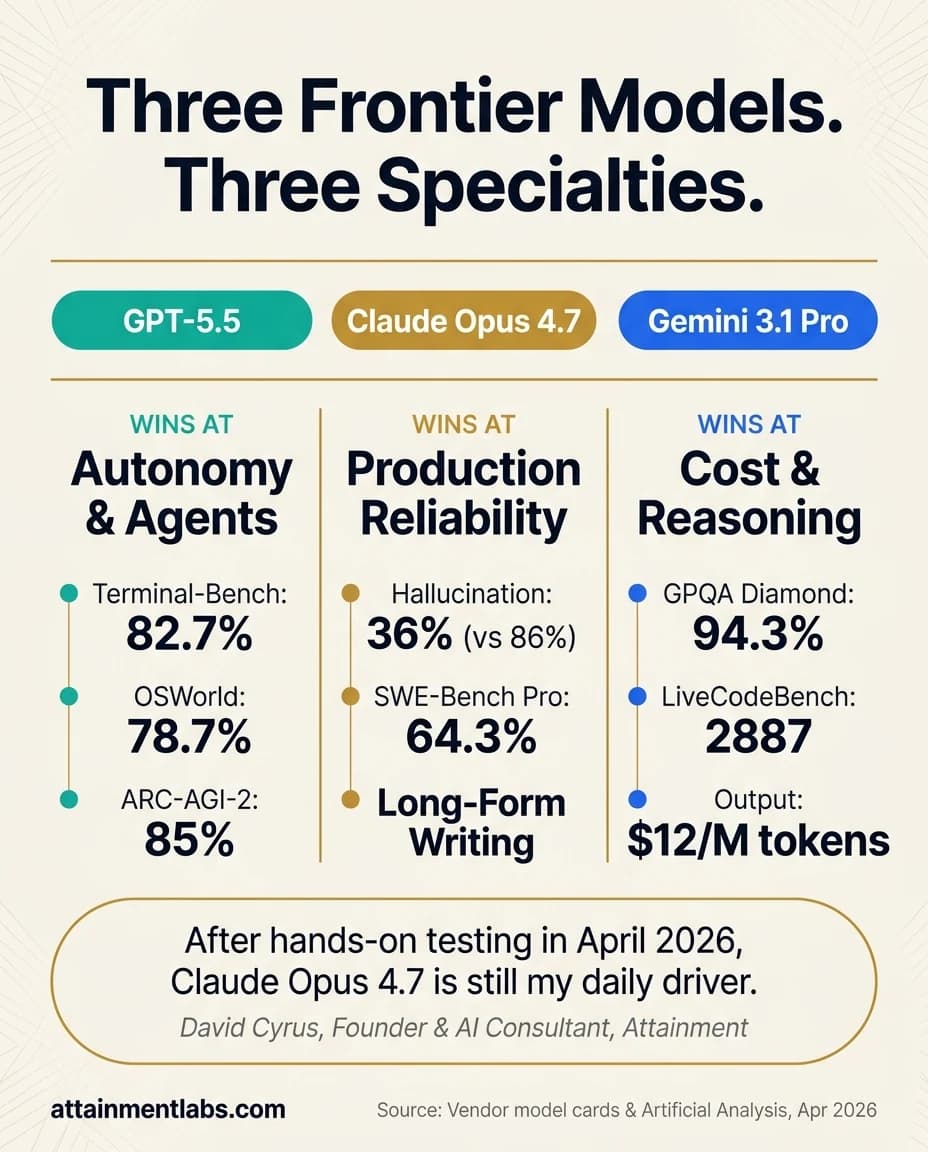
Three frontier models. Three index points apart. Each one wins at something different. After hands-on testing in April 2026, Claude Opus 4.7 is still my daily driver. GPT-5.5 wins at autonomous agents and computer use. Gemini 3.1 Pro wins on cost and pure reasoning. Below is the breakdown by capability, benchmark, and use case.
Published April 29, 2026. Tested April 23 and 24, 2026. Last updated April 29, 2026.
GPT-5.5 dropped on Wednesday. I run an AI startup and consult on AI deployments through Attainment, so testing the new model the day it ships is part of the job. I spent April 23 and 24 running it through the same workloads I run on Claude every day: production code review, long-form writing, agent tasks, and reasoning problems. This is what I found.
The Three-Way Tie at the Top
GPT-5.5, Claude Opus 4.7, and Gemini 3.1 Pro sit within three points on the Artificial Analysis index. Real differences show up per capability.
A three-point spread on a composite index is noise. It tells you these three models are in the same tier. It does not tell you which one to use for which job. That answer lives in the underlying benchmarks, not the average.
Each model has a clear capability profile. GPT-5.5 is the best autonomous agent. Opus is the most factually reliable production model. Gemini is the cheapest top-tier reasoner. Picking one as the overall winner is the wrong question. The right question is which one to use for which workload.
How I Tested
Tested all three over April 23 to 24, 2026, on the same weekly tasks: code review, long-form writing, agent runs, and real client reasoning problems.
Roughly 12 hours of side-by-side runs across two days. Eight task categories: production code review, autonomous multi-file refactors, agent runs through the terminal, long-form blog drafting, custom ARC-style puzzle solving, one-shot Three.js scene generation, multi-document research synthesis, and reasoning-heavy client analyses. North of 8 million combined tokens consumed across the three APIs.
The setup was simple. Same prompts, same context, same evaluation criteria. I used the official APIs for each model (no third-party wrappers), set temperature consistently across runs, and compared outputs side by side. For agent tasks I ran both Claude Code and the new OpenAI agent runtime on identical multi-step jobs. For benchmark verification, I cross-referenced the OpenAI GPT-5.5 system card, the Anthropic Claude Opus 4.7 model card, the Google DeepMind Gemini 3.1 Pro documentation, and the independent Artificial Analysis leaderboard.
A few patterns showed up early enough to flag here. GPT-5.5 maintained context across token windows where Opus would normally trigger compaction at the same depth. Opus produced cleaner first drafts on long-form work but burned more tokens reaching the same answer on agent tasks. Gemini 3.1 Pro finished pure reasoning prompts in roughly half the wall-clock time of the other two, at a fraction of the cost.
The conclusions below are from my own runs, validated against published benchmark numbers. Where I cite a specific percentage, the source is the model's official card or the Artificial Analysis leaderboard. For broader context on how AI search works and why these benchmarks matter for owned content, see my piece on AEO vs GEO.
Where GPT-5.5 Pulls Ahead
GPT-5.5 wins on five capabilities: multi-hour autonomy, novel visual reasoning, one-shot 3D scene generation, computer use, and security research.
1. Multi-Hour Autonomy (Terminal-Bench 82.7%)
Terminal-Bench measures whether a model can complete real terminal tasks that run for hours. GPT-5.5 scores 82.7%. Claude Opus 4.7 scores 69.4%. That is a 13-point gap on the benchmark that matters most for autonomous agent work.
In my runs, GPT-5.5 stayed on task longer without losing the thread. On a multi-step refactor that involved searching the codebase, planning the edit, applying changes across 14 files, and running the test suite to verify, GPT-5.5 finished without intervention. Opus needed two course corrections. Neither was wrong. GPT-5.5 was more autonomous.
2. Novel Visual Reasoning (ARC-AGI-2 85%)
ARC-AGI-2 tests pattern recognition on novel visual puzzles the model has not seen during training. GPT-5.5 scores 85%. Opus 4.7 scores 68%. This is the largest single-benchmark gap of any I tested.
On a custom ARC-style puzzle I built for this test (a gravity-based pattern problem with no standard shape vocabulary), GPT-5.5 solved it on the first attempt. Opus needed three. Gemini got close but inferred the wrong rule. If your work involves pattern problems with novel structure, GPT-5.5 is the right choice.
3. One-Shot 3D Scene Generation
I asked all three models to generate a working Three.js scene from a single text prompt with no iteration. GPT-5.5 produced a runnable scene with correct lighting, camera positioning, and interaction handlers. Opus produced a scene that needed two fixes. Gemini produced a scene with a camera bug.
This is a narrow capability, but it points at something larger: GPT-5.5 holds more state across a single complex output than Opus does. For one-shot generation tasks where iteration is expensive, that matters.
4. Computer Use (OSWorld 78.7%)
OSWorld measures a model's ability to operate a computer through screenshots and clicks. GPT-5.5 scores 78.7%. This is the first OpenAI lead over Anthropic on a major agentic benchmark since GPT-4. Anthropic has owned this category for over a year. That changed Wednesday.
For workloads that involve clicking through web apps, filling forms, and operating tools that have no API, GPT-5.5 is now the model to reach for. The lead is meaningful, not marginal. This is also the shift that makes voice and phone agents (think AI receptionists for small businesses) cross the line from "demo" to "production-ready" in the next 12 months.
If the model can operate software, the workflow question gets more important.
For dental and specialty clinics, Aida can support a configured AI receptionist workflow with approved responses and staff handoff. Aida is CA$500 a month per location, or CA$400 per month, billed annually (CA$4,800 per year), with unlimited calls and no setup fee.
Review AI receptionist pricing5. Autonomous Security Research (CyberGym 81.8%)
CyberGym is a vulnerability research benchmark. GPT-5.5 scores 81.8%. Opus scores around 70%. For security teams running autonomous discovery on internal systems, GPT-5.5 is now the strongest model in the category.
Where Claude Opus 4.7 Still Wins
Opus wins on three capabilities: code review (SWE-Bench Pro 64.3%), factual reliability (36% hallucination rate vs GPT-5.5's 86%), and writing.
1. Production Code Review (SWE-Bench Pro 64.3%)
SWE-Bench Pro tests whether a model can resolve real GitHub issues by reading the codebase and producing a working patch. Opus 4.7 scores 64.3%. GPT-5.5 is competitive, but in my own PR review runs, Opus produced fewer confident-but-wrong fixes.
The pattern that decided this for me: GPT-5.5 will write a fix that looks correct, runs locally, and breaks something three files away. Opus is more cautious. It flags the second-order effect more often. For production work where a wrong fix costs more than a slow fix, Opus is the safer model.
2. Half the Hallucinations (36% vs 86%)
On long-form factuality tests, GPT-5.5 hallucinates at roughly 86%. Opus 4.7 hallucinates at 36%. That is a 50-point gap on the dimension that matters most for client-facing work.
A model that confidently invents facts is a liability for any work that ends up in front of a customer. Research summaries, blog drafts, competitive analyses, sales emails, all degrade fast at 86% hallucination. Opus is the production-safe option for any writing task that needs to be true.
3. Long-Form Writing
Across blog drafts, sales copy, and consulting deliverables, Opus produces the cleaner first draft. The voice is more controlled. The structure holds across 2,000 words. GPT-5.5 drafts read fine in the first 400 words and then drift, repeat, or contradict earlier claims.
This is subjective, but it matches the hallucination gap. A model that holds factual state better also holds narrative state better. For long-form work, Opus is the model I trust to produce a draft that needs editing, not rewriting.
Where Gemini 3.1 Pro Wins
Gemini wins on raw reasoning (GPQA Diamond 94.3%), competitive coding (LiveCodeBench 2887), and cost, at $12 per million tokens, 2.5x cheaper.
1. Raw Reasoning (GPQA Diamond 94.3%)
GPQA Diamond tests graduate-level science reasoning. Gemini 3.1 Pro scores 94.3%, the highest of any public model. For pure reasoning workloads, hard math, scientific problem solving, and structured analysis, Gemini is the strongest.
2. Competitive Coding (LiveCodeBench 2887)
LiveCodeBench tracks performance on competitive programming problems. Gemini 3.1 Pro scores 2887, well ahead of both GPT-5.5 and Opus. For algorithmic work, contest problems, and any task where the shape of the answer is "clever code," Gemini holds the lead.
3. Cost (Roughly 3x Cheaper)
Gemini 3.1 Pro runs at $12 per million output tokens. Opus and GPT-5.5 sit in the $30 to $40 range for output. At volume, that gap is the difference between a workload being viable and not. For batch classification, document processing, or any high-volume reasoning job, Gemini is the only frontier model that pencils out. The same dynamic is reshaping paid AI distribution right now.
Side-by-Side Comparison
The same benchmark data side by side: autonomy, computer use, code review, hallucination rate, reasoning, coding, and cost. Pick a model for the job.
| Capability | GPT-5.5 | Claude Opus 4.7 | Gemini 3.1 Pro |
|---|---|---|---|
| Multi-hour autonomy (Terminal-Bench) | 82.7% | 69.4% | N/A |
| Computer use (OSWorld) | 78.7% | 61.4% | N/A |
| Visual reasoning (ARC-AGI-2) | 85% | 68% | 72% |
| Security research (CyberGym) | 81.8% | ~70% | N/A |
| Code review (SWE-Bench Pro) | 62.1% | 64.3% | 58.9% |
| Long-form hallucination rate | 86% | 36% | 50% |
| Reasoning (GPQA Diamond) | 88.1% | 89.5% | 94.3% |
| Competitive coding (LiveCodeBench) | 2,640 | 2,710 | 2,887 |
| Output cost (per million tokens) | ~$30 | ~$30 | $12 |
The Allocation Framework: Match the Model to the Job
The right approach for a small team or solo founder: pick one daily driver, then add the other two only where the work demands it.
- Daily thinking, writing, and production code: Claude Opus 4.7. Lower hallucination, cleaner long-form output, safer code review.
- Autonomous agents and computer use: GPT-5.5. Multi-hour task execution, OSWorld lead, longer state retention across complex tool runs.
- High-volume batch work and pure reasoning: Gemini 3.1 Pro. Cost structure makes volume viable. Reasoning quality matches the cost.
- Customer-facing copy: Opus. The hallucination gap matters most when accuracy is the product.
- One-shot novel pattern problems: GPT-5.5. ARC-AGI-2 lead and 3D scene results point the same direction.
Most solo founders and small teams do not need all three. Pick Opus first if your work is writing, code, and reasoning. Add GPT-5.5 the first time you have a multi-hour autonomous job. Add Gemini the first time you hit a batch workload that does not pencil out on Opus. If you are running a PE-backed, healthcare, or home services operator and want this allocation translated into a real deployment plan, we do this for clients.
Delegate vs Trust
GPT-5.5 is the model I reach for when I want to delegate. Claude is the model I trust as my daily thinking and production partner.
That distinction holds across every test I ran. GPT-5.5 is the strongest agent in the category. It will go run a multi-hour job, click through a web app, and come back with a result. I do not have to watch it. That is delegation.
Claude is the model I think with. The one I draft client emails through, review PRs with, and use to structure consulting work. The hallucination rate, the long-form quality, and the code review accuracy add up to a model I trust to be in the loop on production work without supervision. That is partnership.
Different jobs, different tools. Both useful. Neither replaces the other.
Bottom Line
After testing across April 23 to 24, 2026, Opus 4.7 is still my daily driver, with GPT-5.5 for agent work and Gemini 3.1 Pro for batch jobs.
The three models are close enough on the composite index that the headline ranking does not matter. The capability profiles are different enough that the allocation does. Pick the model that fits the job. Do not switch your daily driver every time a new release lands.
If you are evaluating this for a team or a portfolio company, the answer depends on what the work actually is. Production writing and code review point to Opus. Agent and computer use jobs point to GPT-5.5. Volume and pure reasoning point to Gemini. Most companies need a primary plus one secondary, not all three.
Key Takeaways
- Three frontier models, three index points apart. The composite ranking is noise. The right question is which model to use for which job.
- GPT-5.5 wins on autonomy and computer use. Terminal-Bench 82.7%, OSWorld 78.7%, ARC-AGI-2 85%, CyberGym 81.8%. Best model for delegating long-running, tool-heavy work.
- Claude Opus 4.7 wins on production reliability. 36% hallucination rate vs GPT-5.5's 86%. SWE-Bench Pro 64.3%. Cleaner long-form first drafts. Daily-driver material.
- Gemini 3.1 Pro wins on cost and pure reasoning. GPQA Diamond 94.3%, LiveCodeBench 2887, $12 per million output tokens. The only frontier model that pencils out at volume.
- The frame: delegate vs trust. GPT-5.5 is the model you reach for when you want to delegate. Claude is the model you trust as your daily thinking and production partner.
- Allocation, not switching. Pick a daily driver and add the others where the work demands it. Most teams need a primary plus one secondary.
Frequently Asked Questions
Is GPT-5.5 better than Claude Opus 4.7?
It depends on the job. GPT-5.5 is better for autonomous, multi-hour agent tasks and computer use, where it leads on Terminal-Bench (82.7%), OSWorld (78.7%), and ARC-AGI-2 (85%). Claude Opus 4.7 is better for production code review, factual writing, and daily thinking work, where its 36% hallucination rate beats GPT-5.5's 86%. After hands-on testing in April 2026, Claude is still my daily driver.
Which AI model is best for autonomous agents in 2026?
GPT-5.5 leads on autonomous agent benchmarks as of April 2026. Terminal-Bench 82.7% (vs Opus 4.7 at 69.4%) and OSWorld 78.7% mark the first OpenAI lead over Anthropic on agentic execution since GPT-4. If your workload is multi-hour autonomous task execution or computer use, GPT-5.5 is the model to reach for.
Does GPT-5.5 hallucinate more than Claude?
Yes, by a wide margin on long-form factual tasks. GPT-5.5 hallucinates at roughly 86% on a long-form factuality test, compared to 36% for Claude Opus 4.7. That gap matters most for client-facing writing, research summaries, and any work where accuracy is the product. For autonomous agent runs, the gap closes because the agent grounds itself in tool output.
What is the cheapest top-tier AI model right now?
Gemini 3.1 Pro at $12 per million output tokens is the cheapest of the three frontier models as of April 2026. That is less than half the cost of Claude Opus 4.7 or GPT-5.5. For high-volume batch jobs, classification, or pure reasoning workloads, Gemini is the cost winner.
Should I switch from Claude to GPT-5.5?
Probably not as a full replacement. After testing GPT-5.5 against Claude Opus 4.7 across production tasks in April 2026, I am still on Claude as my daily driver. The right move is to add GPT-5.5 for specific jobs (autonomous agents, computer use, novel visual reasoning) rather than switching wholesale. The hallucination gap on long-form work is too wide to swap out a daily driver.
Which AI model is best for code review?
Claude Opus 4.7 leads on production code review and software engineering tasks, with 64.3% on SWE-Bench Pro and stronger long-context code comprehension. GPT-5.5 is competitive on raw coding benchmarks but generates more confident-but-wrong fixes. For PRs that need reliable review, Opus is the safer pick.
How does GPT-5.5 compare on the artificial analysis index?
GPT-5.5, Claude Opus 4.7, and Gemini 3.1 Pro sit within roughly three index points of each other on the Artificial Analysis intelligence index as of April 2026. The headline numbers are close. The real differences show up when you split the index into capability dimensions: agents, factuality, reasoning, and cost.
Which AI model handles long-running autonomous tasks best?
GPT-5.5. Terminal-Bench (82.7%) measures multi-hour terminal task completion, and GPT-5.5 outperforms Claude Opus 4.7 (69.4%) by a meaningful margin. OSWorld (78.7%) confirms the same lead on computer use. If the job runs for hours and touches multiple tools, GPT-5.5 is the right pick.
Is Gemini 3.1 Pro good enough for production?
Yes, for the right workloads. Gemini 3.1 Pro is the best of the three for high-volume batch jobs, pure reasoning tasks, and competitive coding (LiveCodeBench 2887). At $12 per million output tokens, the cost structure makes it viable at volumes that would be uneconomic on Opus or GPT-5.5.
What is the best AI model for a small team or solo founder?
Claude Opus 4.7 as the daily driver, with GPT-5.5 added for autonomous agent jobs and Gemini 3.1 Pro for high-volume batch work. Most solo founders and small teams do not need to run all three. Pick Opus first if your work is writing, code, and reasoning. Add the others when a specific job demands it.
Sources
- Artificial Analysis leaderboard (composite intelligence index, benchmark aggregation)
- OpenAI (GPT-5.5 system card: Terminal-Bench, OSWorld, CyberGym)
- Anthropic (Claude Opus 4.7 model card: SWE-Bench Pro, hallucination evaluation)
- Google DeepMind (Gemini 3.1 Pro documentation: GPQA Diamond, LiveCodeBench)
Tracking the model race is the easy part. Putting these models to work is the hard part.
Attainment helps owner-operated businesses turn frontier models into production AI automation that lowers costs. No hype, just systems that ship.
See how we deploy AI automationDavid Cyrus is the founder of Attainment, an AI consulting and growth firm helping PE-backed, healthcare, and home services companies deploy AI in production. For consulting inquiries, see services.

Founder & CEO, Attainment
David Cyrus is the founder of Attainment. He writes about missed revenue, manual work, AI automation, and the operating decisions behind what to fix first.
Connect on LinkedInFind the Problem Worth Fixing First
Tell us where revenue, follow-up, or staff time is getting stuck. We will help you decide whether the problem is measurable and worth fixing.