Do Customers Mind Talking to AI? What Pew's Survey Says About the Line People Draw

Do customers mind talking to AI? It depends on the job. People accept AI doing a task for them, and they push back when it fakes care, judgment or the voice of someone they trust. For a business deciding what to hand to an AI agent, that is the line to draw.
What Pew asked in its AI customer service survey, and what it found
Pew asked 5,023 U.S. adults how they would react to learning AI was involved in seven situations. Customer service drew 41% negative.
The Pew Research Center short read "From political speeches to songs: How would Americans react if they found out AI was involved?" was published September 17, 2025. It reports a survey of 5,023 U.S. adults taken June 9 to 15, 2025. Pew described seven situations and asked how each person would react on later learning that AI was involved.
The table shows the share who would react negatively and the share who said it would make no change.
| Situation | Would react negatively | No change |
|---|---|---|
| A political candidate's speech they liked | 71% | 25% |
| A loan decision about them | 57% | 35% |
| A news article they felt informed by | 56% | 36% |
| A painting they liked | 49% | 48% |
| A doctor's promising treatment recommended by AI | 45% | 41% |
| A customer service experience with an AI chatbot | 41% | 53% |
| A song they liked | 38% | 58% |
Source: Pew Research Center, September 17, 2025.
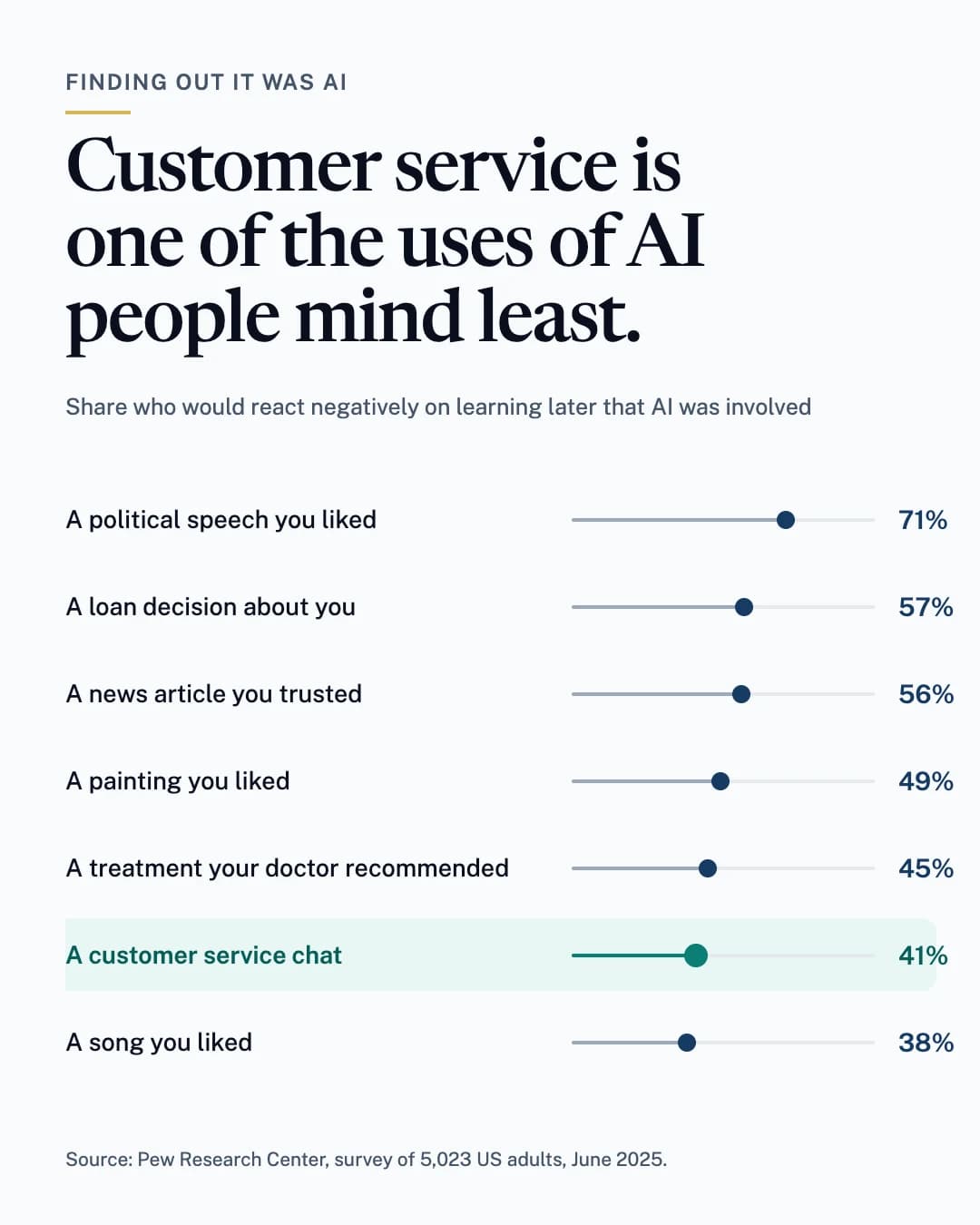
The doctor's treatment drew the largest share saying they would feel better, 13%. For customer service with an AI chatbot, 41% said they would feel worse and 53% said it would make no change. Only the song drew a milder reaction on both measures.
The pattern across the seven: tasks on one side, trust and voice on the other
The strongest reactions sit where AI stands in for judgment or a trusted voice. Customer service and a song drew milder ones.
Four situations ask you to trust a person's judgment or word: the speech, the loan decision, the news article and the doctor's treatment. They drew 71%, 57%, 56% and 45% negative. Learning that AI was behind them changes what you thought you were trusting.
Three situations are different: customer service, a song and a painting. In each, the person receives a result or enjoys a work, and no reaction passed 49%.
Two cautions. The painting does not fit neatly. At 49% negative against 48% no change it is a near split, and 49% is above the 45% for the doctor's treatment. Pew also reports that younger Americans were far more likely than older Americans to react negatively to an AI-made song or painting, so creative work looks like its own case, where people care who made it.
The song, at 38% negative and 58% no change, is milder than customer service. That is why I say customer service is one of the uses people mind least, not the least.
The grouping is my reading. Pew reports the figures.
Do customers mind talking to AI? What it means for your phone and chat
Pew's figures suggest customers are fairly relaxed about AI doing the task. The risk sits in moments that need care, judgment or a trusted voice.
Start with the task. When an AI agent answers a question, books a visit or takes a message, the customer cares that it gets done. Pew's customer service figures fit that, though 41% is a large minority who said they would feel worse. Treat it as room to start, not a green light for everything.
Keep the empathy moments with your people: a frightened caller, bad news, a complaint, a decision that needs judgment. These are the care, judgment and trusted voice behind the stronger reactions in the survey. Make it easy for the agent to hand them to someone on your team.
Be straight about what the agent is when a customer asks. Pew asked about finding out afterwards, so it measured the reaction to a discovery, not to being told.
The line to hold: five principles
Hold the line at care, judgment and trusted voices. Give an AI agent the tasks around them, and test it one job at a time.
- Give the task to the AI agent. Answering, booking, taking messages and following up.
- Keep care with your people. Distress, bad news and complaints go to someone on your team.
- Keep judgment with your people. Decisions about a person's money or health need a named human.
- Never borrow a trusted voice. Do not use AI to speak as the owner or the practitioner in words they did not say.
- Be straight about what it is. When a customer asks, answer plainly, then offer a person.
What the survey does not tell you
Pew measured hypothetical reactions of U.S. adults. It did not measure what people do, or ask about calls to a clinic or a trades business.
People were asked how they would feel on learning AI was involved. Nobody watched what they did next: whether they complained, left or stayed.
Pew did not ask about clinic or trades calls, and it did not single out a spoken call. Its customer service situation named an AI chatbot. It covered seven situations and surveyed adults in the United States only.
Read it as a guide to where people push back. The best test of your own line is your own customers.
AI customer service survey: questions owners ask
Short answers to common questions about Pew's survey and what it means for a business using an AI agent on the phone or chat.
Do customers mind talking to AI?
Some do, and it depends on the job. In Pew's survey, 41% said they would feel worse on learning a customer service experience involved an AI chatbot, and 53% said it would make no change. Reactions were stronger for political speeches, news, loan decisions and a doctor's treatment. The survey asked about hypothetical reactions, not behaviour.
What did the Pew AI customer service survey find?
Pew asked 5,023 U.S. adults, June 9 to 15, 2025, how they would react to learning AI was involved in seven situations. For customer service with an AI chatbot, 41% would feel worse and 53% saw no change. Political speeches drew the most negative reaction, at 71%, and a song the least, at 38%.
Is customer service the use of AI people mind least?
Not quite. It is one of the uses people mind least. A liked song drew a lower negative reaction, 38%, than customer service at 41%, and more people said it would make no change, 58% against 53%. Both sit below the 71% for a political speech.
Where should a business draw the line between AI and its own people?
My read: let the AI agent do tasks such as answering questions, booking and taking messages, and keep moments that need care or judgment with your own people. Do not use AI to speak in the voice of someone customers trust, and answer honestly when a customer asks what they are talking to.
Does this survey apply to clinics and trades businesses?
Pew did not ask about clinic or trades calls, so it cannot say. It surveyed U.S. adults on seven situations, including customer service with an AI chatbot, and asked how they would react on later learning AI was involved. Treat it as a guide to where people push back, then test with your own customers.
Does it matter if customers know they are talking to an AI agent?
Pew asked how people would react on later learning AI was involved, so it does not test being told upfront. My read is that plain honesty about what the agent is leaves customers nothing to find out later, which is the moment Pew measured. Check the rules that apply where you operate.
Attainment makes Aida, the AI agent that takes the repetitive work, and the line above is the one we design it around: see Aida.

Founder & CEO, Attainment
David Cyrus is the founder of Attainment. He writes about missed revenue, manual work, AI automation, and the operating decisions behind what to fix first.
Connect on LinkedInFind the Problem Worth Fixing First
Tell us where revenue, follow-up, or staff time is getting stuck. We will help you decide whether the problem is measurable and worth fixing.